

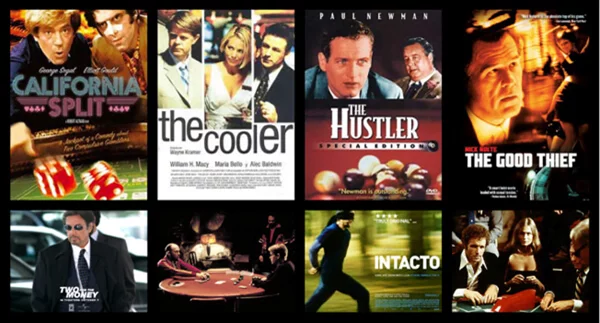
From the smoky backrooms of London to the high-stakes glamour of Monte Carlo, casino films have long held a mirror to our fascination with fortune and fate. They transport us into a world of velvet ropes and clinking chips, where a single hand can change a destiny. This exploration delves into the rich tapestry of the casino movie genre, celebrating iconic British contributions like the gritty realism of Croupier and the suave sophistication of James Bond, while also acknowledging the influential American classics and compelling global stories that have defined our cinematic love affair with the gamble.
The British Grit: UK’s Unique Take on Casino Drama
While Hollywood often sells the neon-drenched fantasy of instant riches, British casino films possess a distinctive, grounded edge. They are less concerned with the fleeting thrill of the win and more focused on the psychological toll, the grim mechanics, and the moral ambiguity of the gaming world. This realist tradition offers a compelling counter-narrative to the genre’s usual glamour, exploring the characters who operate in the shadows of the tables.
The Croupier: A London Classic
A quintessential entry in the canon of British casino films is Mike Hodges’ 1998 masterpiece, Croupier. Set in the anonymous, rain-slicked heart of London’s gambling scene, it stars Clive Owen as Jack Manfred, an aspiring writer who takes a job dealing cards. The film is a masterclass in atmospheric tension, using the casino not as a place of excitement, but as a sterile, oppressive theatre of human frailty. Jack’s detached, cynical narration—”I had to be the still centre of the wheel”—epitomises the UK’s focus on the observer, the controller who remains emotionally disengaged from the fate of the players he serves.
Beyond Glamour: The UK’s Realist Edge
This tradition continues in modern cinema. Films like Paul Schrader’s The Card Counter (2021), while American in setting, channel a profoundly British, psychological sensibility through its solitary, tormented protagonist. The UK’s approach strips away the spectacle to ask harder questions about compulsion, consequence, and the search for control in a universe governed by chance. It’s a perspective born from a film culture that values character study and social observation as much as plot, making its contributions to the genre uniquely insightful and enduring.
Bond, James Bond: Casino Royale and the UK’s Most Famous Card Game
No discussion of British casino films is complete without 007. The 2006 reboot Casino Royale not only redefined James Bond for a new generation but also delivered one of the most tense and pivotal casino sequences in cinematic history. The film cemented the UK’s intrinsic link to cinematic high-stakes, framing the poker table as a battlefield for national security and personal vendetta.
Pinewood’s Poker Table: Filming Casino Royale
The iconic casino scenes, where Bond faces off against terrorist financier Le Chiffre, were meticulously crafted not in a foreign casino, but on a soundstage at the legendary Pinewood Studios in Buckinghamshire. This bastion of British filmmaking manufactured the opulence of Montenegro’s Casino Royale, demonstrating that the most compelling gambling atmospheres are often born from imagination and technical artistry. The choice of Texas Hold’em poker, a game of skill, bluff, and nerve, perfectly mirrored the film’s mission to showcase a more vulnerable, tactical Bond.
Bond’s Bluff: More Than Just a Game
In Casino Royale, the card game is the plot’s crucible. Every raise, call, and tell is laden with meaning. Bond’s victory is not merely about winning money; it’s about psychologically destroying his enemy, proving his worth to MI6, and, crucially, surviving a poisoning mid-game. The sequence masterfully uses the casino setting to explore the character’s core traits: his cold nerve, his calculating mind, and his capacity to endure immense pain. It transforms a game into a matter of life and death, forever associating the UK’s premier spy with the ultimate high-stakes gamble.
American Classics: Vegas and the Allure of the Win
American cinema has crafted the dominant mythology of the casino film, with Las Vegas serving as its spiritual home. These films trade British realism for grand operatic scale, exploring the creation, operation, and spectacular downfall of gambling empires. They have provided the genre with some of its most enduring icons and tropes.
Scorsese’s Masterpiece: ‘Casino’
Martin Scorsese’s 1995 epic, Casino, stands as the definitive film about the machinery of Vegas. Starring Robert De Niro as fastidious casino boss Sam “Ace” Rothstein, it is a sprawling, brutal saga of greed, power, and corruption. Scorsese’s film is less about the joy of gambling and more a forensic examination of its ecosystem. Key elements the film immortalised include:
- The intricate, behind-the-scenes mechanics of casino security and fraud prevention.
- The volatile, toxic relationship between the organised crime underworld and corporate gambling.
- The city itself as a character—a glittering desert mirage built on a foundation of violence and compromise.
The Heist Genre: ‘Ocean’s Eleven’ and Style
On the opposite end of the tone spectrum sits Steven Soderbergh’s Ocean’s Eleven (2001). This film re-popularised the casino heist with unparalleled slickness and wit. Set in the fictional Bellagio-like casinos of the Las Vegas Strip, it prioritises style, camaraderie, and ingenious plotting over moral quandary. The casino is presented as an impenetrable fortress of wealth, making its takedown by Danny Ocean’s crew a triumphant, victimless fantasy. It cemented the image of the casino as the ultimate playground for the cool and clever.
Global Ante: Casino Films from Around the World
The fascination with gambling and its consequences is a global phenomenon, reflected in cinema from diverse cultures. These films often use the casino or high-stakes card game as a lens to examine broader societal or philosophical issues, offering perspectives distinct from the Anglo-American mainstream.
Karel Reisz’s The Gambler (1974) is a harrowing American film with an existential, European art-house sensibility. It delves deep into the psychology of addiction, portraying the protagonist’s self-destructive need for risk as a perverse search for authenticity in a numb world. Conversely, Aaron Sorkin’s Molly’s Game (2017) tells the based-on-truth story of Molly Bloom, who ran the world’s most exclusive underground poker game. It shifts the focus from the players to the entrepreneur, exploring themes of power, celebrity, and the legal grey areas of providing a service for an insatiable appetite for risk.
Why We Bet: The Enduring Appeal of the Casino Film
Across borders and decades, the casino film retains its powerful grip on audiences. This enduring appeal stems from its ability to dramatise fundamental human conditions within a visually and emotionally charged setting.
Themes of Risk and Redemption
At their core, these films are about risk. They place characters in high-pressure situations where their true nature is revealed. Will they fold or go all in? This metaphorical framework allows for explorations of redemption, ruin, moral compromise, and the age-old battle between luck and skill. The casino becomes a modern-day coliseum where internal conflicts are fought with chips and cards.
Cinematic Glamour vs. Harsh Reality
The genre expertly navigates the tension between seduction and consequence. It sells the dream—the designer clothes, the free-flowing champagne, the adrenaline rush of a winning streak—while almost invariably revealing the grim reality underneath: the addiction, the debt, the corruption, and the loneliness. This duality is irresistible; it allows us to indulge in the fantasy while safely confronting its dangers from our cinema seat.
Ultimately, the best casino films, from British character studies to Hollywood spectacles, succeed by showing us that the biggest gamble is always on human nature itself.